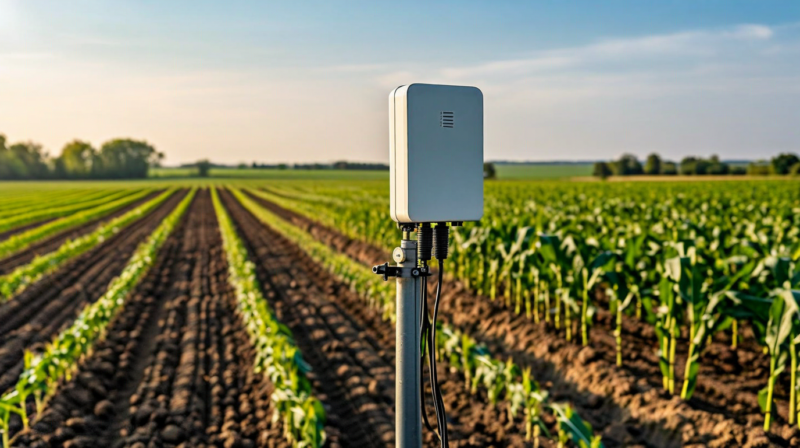
The choice between LoRaWAN and cellular (LTE-M or NB-IoT) for agricultural soil sensor networks gets simplified to "LoRaWAN is cheaper, cellular is more reliable" in most vendor comparisons. That framing is directionally correct but leaves out enough detail to be practically misleading. In 2024, we ran a structured comparison across 14 test sites in Iowa and Illinois, measuring packet delivery rate, power draw, deployment cost, and latency across the full growing season. This article presents the numbers and provides decision criteria for operations of different scales and connectivity constraints.
Test Setup and Methodology
Each of the 14 test sites deployed matched sensor arrays: three SDI-12 soil moisture probes (15 cm, 30 cm, 60 cm depth) and one temperature/humidity node at canopy height. Half the sites used a LoRaWAN node connected to a field-deployed gateway operating on the 915 MHz US ISM band, using Chirpstack as the network server. The other half used LTE-M modems with SIM cards from two carriers for redundancy. All sensors transmitted readings every 30 minutes throughout the April-to-October period. We tracked packet delivery rate, transmission timestamp versus receive timestamp, battery voltage over time, and frequency of manual intervention required.
Site selection covered three landscape categories: open flat terrain (6 sites), moderately rolling terrain (5 sites), and parcels adjacent to tree lines or grain bins that create obstacles (3 sites). The obstacle category is where the two protocols diverged most significantly, and it is the category most relevant to operations with mixed field configurations.
Packet Delivery Rate: Where LoRaWAN Struggles
On open flat terrain with gateway placement at field center, LoRaWAN achieved 96.4 percent packet delivery rate across the season - adequate for a sensor network where individual missed readings can be interpolated. The picture changed in dense canopy periods. Between V8 and tasseling, when the corn canopy was fully developed and sensor nodes were physically below the leaf surface, LoRaWAN packet delivery on the flat-terrain sites dropped to 88.7 percent. This was expected: corn canopy at full cover attenuates 915 MHz signals by approximately 8 to 12 dB, reducing effective range and increasing packet errors near the gateway sensitivity threshold.
On sites with obstacles (tree lines, grain bins, or both), LoRaWAN performed substantially worse: 84.2 percent during open canopy periods, falling to 72.8 percent during full canopy. This means roughly one in four sensor readings is missing during the critical mid-July through early August window. For irrigation scheduling purposes, this gap forces the water balance model to fall back on Penman-Monteith ET calculations without sensor confirmation for a significant fraction of the peak-demand period. LTE-M on the same obstacle-affected sites delivered 98.1 percent packet success throughout the season - the cellular network's tower-based architecture is not affected by near-field vegetation or building obstacles in the same way.
Power Consumption and Battery Life
LoRaWAN's primary advantage in power consumption is genuine and significant. The LoRa modulation scheme achieves very low transmit current draw (typically 30 to 40 mA for a few hundred milliseconds per transmission), and sleep current between transmissions is on the order of 1 to 5 microamps. A sensor node transmitting every 30 minutes can operate for 3 to 5 years on two standard AA lithium cells, assuming no continuous peripherals. Field deployments with solar supplementation can effectively run indefinitely.
LTE-M power consumption is substantially higher. A typical LTE-M module draws 100 to 200 mA during active transmission, with PSM (Power Saving Mode) reducing inter-transmission sleep current to below 10 microamps. With 30-minute transmission intervals and no solar, AA-battery runtime is typically 6 to 12 months depending on temperature (cold reduces battery capacity). NB-IoT offers slightly lower peak current than LTE-M but at the cost of higher transmission latency, which matters for real-time alert applications. In our test deployment, LoRaWAN nodes averaged 14 months of battery life before voltage dropped to the warning threshold, versus 7 months for LTE-M nodes. For operations with 50 or more sensor nodes, the battery replacement labor cost difference is material.
Gateway Costs and Infrastructure Requirements
LoRaWAN requires a gateway at the field edge or mounted on an existing structure within range of the sensor nodes. A commercial outdoor gateway (IP67 rated, 8-channel, with Ethernet or cellular backhaul) costs approximately $300 to $600. Gateway range in flat terrain is typically 1 to 3 km line-of-sight in the ISM band - adequate to cover a quarter section from a single gateway installed at a field corner or on a pivot control panel post. Fields larger than 640 acres or fields with significant terrain variation typically require multiple gateways.
Cellular nodes require no field infrastructure beyond the node itself and a SIM subscription. At current LTE-M pricing (typically $3 to $8 per SIM per month for agricultural data plans with reasonable transmission budgets), a 20-node deployment runs $60 to $160 per month in data costs. LoRaWAN's per-node data cost is near-zero once the gateway is installed, making it substantially less expensive per node per year for large deployments. The crossover point where cellular's higher reliability justifies its higher per-node operating cost depends on the operation's tolerance for missed readings and the density of obstacles in the specific field configuration.
Latency and Real-Time Alert Applications
For standard 30-minute interval soil moisture reporting, latency differences between LoRaWAN and LTE-M are not operationally significant. Both protocols deliver sensor readings to the cloud within seconds to minutes of transmission. The latency distinction matters for two specific scenarios: (1) real-time flood or over-irrigation alerts where a sensor at 15 cm needs to trigger an alarm within minutes of the reading, and (2) adaptive irrigation control where sensor readings directly feed a valve controller decision loop rather than just informing a human scheduler.
For scenario 2 specifically - direct sensor-to-valve-controller integration - cellular's consistently sub-minute latency profile has advantages over LoRaWAN's variable latency under network congestion or retry conditions. We have seen LoRaWAN end-to-end latency (sensor to application server) spike to 8 to 15 minutes during periods of gateway congestion when multiple nodes attempt retransmission simultaneously. For human-supervised irrigation scheduling where the schedule is set 24 to 48 hours in advance, this latency spike is irrelevant. For operations experimenting with automated closed-loop irrigation control, it is worth noting.
Our Recommendation by Operation Scale
For operations under 500 acres with relatively open terrain and centralized sensor placement, LoRaWAN offers the better economics at comparable reliability. The upfront gateway cost is recovered within two to three seasons compared to cellular data plan costs, and battery life reduces maintenance burden. For operations over 1,000 acres, mixed terrain, or with significant obstacles between sensor nodes and any practical gateway location, LTE-M's reliability advantage justifies its higher operating cost. The packet delivery gap - 28 percent lower on obstacle-affected LoRaWAN sites versus LTE-M in our dataset - creates enough model interpolation uncertainty to affect irrigation scheduling precision in a way that costs real yield.
For operations between 500 and 1,000 acres, the decision is genuinely site-specific. The most useful due diligence is a site survey during full canopy in July: walk the field with a LoRaWAN test transmitter and check signal strength at each proposed sensor location. If every location reads above -120 dBm at the gateway during peak canopy, LoRaWAN is viable. Below that threshold at any critical sensing point, cellular is the more dependable choice. CropKern supports both protocols and both types of sensors are natively integrated with the root-zone water balance calculation described in our article on irrigation scheduling fundamentals. Contact [email protected] for a sensor deployment consultation tailored to your specific field configuration.