CropKern combines daily satellite overpass data with continuous in-field soil telemetry to produce actionable forecasts and irrigation schedules that match how growers actually work.
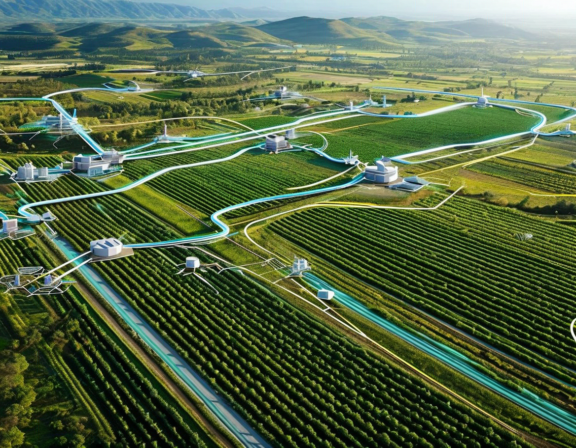
From raw telemetry to a signed irrigation schedule, the pipeline runs in under six hours after each satellite pass.
Upload field boundaries as GeoJSON or draw them in the map editor. Pair LoRaWAN or SDI-12 sensor nodes to each parcel. CropKern validates sensor depth calibration on first contact and flags nodes with drift above 3%. Historical weather data from the nearest ASOS station back-fills before your sensor network was installed.
Each Sentinel-2 Level-2A overpass is atmospherically corrected, cloud-masked, and resampled to 10 m. Band ratios - NDVI, NDRE, NDWI, and SAVI - are extracted per parcel. These are joined to the soil moisture time series, root-zone temperature, and cumulative growing-degree-days to form a 42-feature vector per parcel per day.
A gradient-boosted regression ensemble, trained on six seasons of on-farm weigh-ticket data across corn, soybean, and winter wheat parcels in Iowa, Illinois, and Indiana, scores each feature vector. The model outputs a median forecast with 80% and 95% prediction intervals. Parcels flagged as high-variance receive a caution marker in the dashboard.
Reference ET (Penman-Monteith) is computed using NOAA forecast grids and adjusted by the crop coefficient curve for the current growth stage. The root-zone water balance integrates sensor-measured field capacity, precipitation from the nearest rain gauge, and reported irrigation events to produce a daily depletion percentage.
When root-zone depletion exceeds the management allowed depletion threshold (configurable per crop), CropKern generates an irrigation event. Pump run-time is calculated from parcel area, emitter flow rate, and system efficiency. Output formats: JSON, pivot-controller CSV, and a printable agronomist report with refill depth recommendations.
Anomaly alerts - NDVI deviations over 1.5 standard deviations, canopy temperature spikes above 38 C, or sensor packet loss over 8 hours - arrive in the dashboard, mobile app, and optionally via SMS. Every alert links to the specific satellite band and sensor reading that triggered it, so agronomists can dismiss false positives with one click.
Sentinel-2 (10 m, 5-day revisit), PlanetScope (3 m, daily), and Landsat-9 (30 m, 16-day) feeds are normalized to a common spatial reference frame. Temporal compositing fills cloud gaps using the most recent clear pixel within a 12-day window.
Custom AOI exports in GeoTIFF, COG, and netCDF formats for integration with QGIS, ArcGIS Pro, or R-based analysis pipelines.
Native parsers for Sentek EnviroScan, Campbell Scientific CS616, and Irrometer Watermark protocols. Generic MQTT and Modbus TCP endpoints support third-party hardware without custom integration work.
Sensor data is stored at 15-minute resolution, compressed with zstd, and available through the time-series API with RFC 3339 timestamp filtering.
Pre-built phenology curves for corn (B73, P1197), soybean (Maturity Group III-V), winter wheat (soft red, hard red), and cotton. Custom crop parameters accepted via JSON upload for specialty crops and experimental varieties.
Growth stage detection runs from thermal time accumulation and is validated against satellite canopy closure signals each season.
Every dashboard feature is available through the public REST API. Parcel data, forecast time series, irrigation schedules, and alert events return as JSON or CSV. Pagination uses cursor-based token encoding for stable large dataset retrieval.
Webhook subscriptions push irrigation trigger events to farm management software, ERP systems, and directly to compatible pivot controller endpoints.
All parcel geometries, sensor time series, and yield data are stored in dedicated per-tenant S3 buckets with server-side AES-256 encryption. TLS 1.3 in transit. No data is shared across tenants or used for model training without explicit opt-in consent.
SOC 2 Type I attestation completed March 2025. Type II audit scheduled for Q4 2025.
iOS and Android apps sync the current parcel map and irrigation schedule for offline use. Field scouts mark anomaly polygons on satellite basemaps. Photos taken in the app are tagged with GPS coordinates and parcel ID, stored in the platform timeline alongside spectral data.
Offline queue flushes automatically when LTE connectivity is restored at the field edge.
| Spatial resolution | 10 m per pixel (Sentinel-2) |
| Yield forecast MAE | 4.1 bu/ac (corn, 2023 season) |
| Schedule refresh cycle | Every 48 hours |
| API response time (p95) | Under 210 ms |
| Sensor ingestion lag | Under 4 minutes from packet receipt |
| Max parcels per tenant | Unlimited on Growth and Enterprise |
| Data retention | 7 years on Enterprise |
| Supported crops | 8 pre-built models + custom upload |
We provide a 30-day evaluation using your parcel boundaries and the last full season of Sentinel-2 archive data. You see the forecast accuracy before committing to a subscription.
Request a Demo