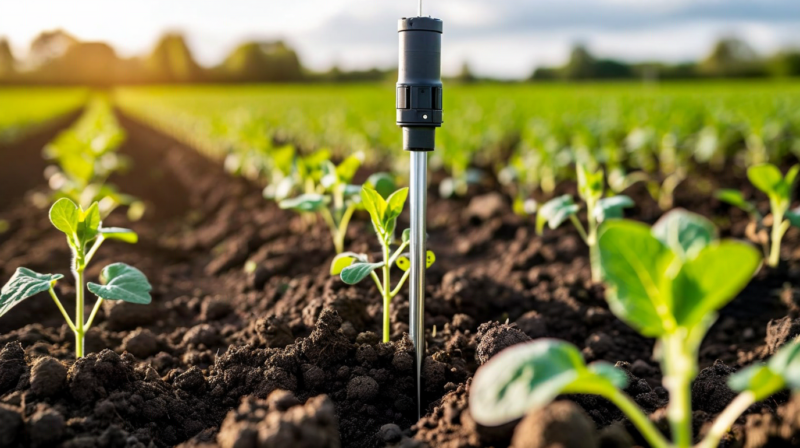
SDI-12 (Serial Digital Interface at 1200 baud) is the protocol that most soil moisture sensors in agricultural deployments use to communicate with data loggers and wireless gateways. The standard was defined in the 1980s and has become nearly ubiquitous in precision agriculture sensing - capacitance probes, TDR sensors, volumetric water content sensors, soil temperature arrays, and dendrometers all commonly use SDI-12 as their interface. Despite its prevalence, field deployments frequently fail silently because of wiring errors, address conflicts, or power supply issues that are not immediately obvious and that produce intermittent or systematically biased readings rather than clear error messages. This guide covers the practical details of SDI-12 deployment that vendor documentation often underspecifies.
Protocol Basics: How SDI-12 Works
SDI-12 is a half-duplex serial protocol operating at 1200 baud with a single data wire, a ground wire, and a power wire (typically 12V, though 5V is common in some implementations). The data wire alternates between transmit and receive directions - only one device transmits at a time, and the master device (the data logger or gateway) initiates every transaction. Each sensor on a shared bus must have a unique address between 0 and 9, or between 'a' and 'z' for extended addressing (if the controller supports it). The most common bus configuration in agricultural use is a daisy-chained 3-wire cable with multiple sensors connected in parallel along the data, power, and ground lines.
A standard measurement transaction works as follows: the master issues a break signal (holding the data line low for 12 ms), then a mark (data line high for 8.33 ms), then sends an ASCII command string in the format "aMC!" where 'a' is the sensor's address, 'M' is the measurement command, 'C' is an optional subcommand character, and '!' is the terminator. The sensor responds with an acknowledgment indicating how many seconds it needs to prepare data, then the master polls for the data after that delay. This overhead means a single measurement from a single sensor takes approximately 0.5 to 3 seconds depending on the sensor type. With ten sensors on a bus, a full scan takes 5 to 30 seconds - manageable for a 30-minute logging interval but worth knowing for operations considering high-frequency logging.
Address Assignment and Conflict Prevention
The most common cause of silent sensor failure in multi-sensor deployments is address conflict: two sensors shipped from the factory with the same default address (address '0' is the default for almost every SDI-12 sensor on the market) installed on the same bus without re-addressing. When two sensors share address '0', both attempt to respond to every '0' command simultaneously. The responses collide on the single data wire, producing garbled or absent responses that the data logger may log as errors or may silently ignore - depending on the logger's error handling. The result is that neither sensor records any useful data, but the symptom (no data) looks exactly like a failed sensor or a wiring problem.
The fix is straightforward: re-address each sensor before installation. Every SDI-12 sensor has an 'A' (address change) command: "aAb!" changes the sensor at address 'a' to address 'b'. This must be done with each sensor connected individually to the bus - not all sensors installed simultaneously. The standard CropKern sensor deployment protocol requires pre-addressing all sensors before installation and recording the address assignments in the parcel's sensor configuration in the CropKern dashboard. If you are deploying sensors from multiple manufacturers on the same bus, verify that each manufacturer's sensor correctly implements the address change command - some older sensors require a proprietary software tool rather than the standard SDI-12 'A' command.
Power Supply and Bus Capacitance Issues
SDI-12 sensors are specified for 9.6 V to 16 V power supply, but in practice many capacitance-based soil moisture sensors perform calibration at 12V and can show VWC offsets of 2 to 4 percent VWC when supplied at 9.6V versus 12V. This matters because many LoRaWAN nodes and low-power data loggers run their sensor supply rail at 5V or 3.3V and use a boost converter to reach the nominal 12V SDI-12 supply. The boost converter output under load can droop from 12V to 9V when multiple sensors are powered simultaneously during concurrent measurement cycles. Adding a capacitor (typically 100 to 470 uF) on the sensor supply rail reduces the droop and improves measurement consistency.
Bus capacitance also affects maximum cable length and maximum number of sensors on a shared bus. The SDI-12 specification allows up to 200 ft (61 m) of bus length and up to 10 sensors per bus. In practice, with standard 24-gauge instrument cable in direct burial conduit, the capacitance per unit length and sensor input capacitance can limit clean communication to approximately 150 ft and 7 to 8 sensors before signal rise time degradation causes communication failures. For CropKern deployments requiring more than 8 sensors or cable runs over 100 ft, we recommend splitting the installation into two separate SDI-12 buses on separate data logger channels rather than extending the single bus to its limits.
Installation Depth and Soil Contact Quality
The physical installation quality of capacitance sensors directly affects reading accuracy. Poor soil-to-sensor contact - gaps or voids around the sensor body - introduces air pockets that dramatically lower the measured dielectric constant and produce anomalously low VWC readings. At 15 cm depth in a well-cultivated loam, inserting a sensor probe into an augured hole and backfilling with native soil typically produces adequate contact. In clay-heavy soils that tend to crack and gap around the probe during dry periods, slurry backfilling (native soil mixed with deionized water to create a thick paste, packed around the probe before the hole is sealed) significantly improves contact and reduces the drying-season reading artifact where sensors read near-zero as cracks propagate to the sensor face.
For multi-depth installations using access tubes (a single vertical tube with sensors inserted at different depths), verify that the access tube material does not interfere with the sensor's measurement volume. PVC is generally compatible with capacitance sensors when the tube wall thickness is below 3.5 mm. Thick-walled PVC or steel access tubes can reduce effective measurement volume and require sensor-specific calibration corrections that vary by tube material and diameter. Check with your sensor manufacturer for access tube compatibility specifications before selecting tube material and diameter for a multi-depth installation.
Calibration: Factory vs Field-Specific
All capacitance-based SDI-12 soil moisture sensors ship with a factory calibration that converts measured dielectric constant to VWC using a generalized mineral soil equation. The standard Topp equation (VWC = -5.3e-2 + 2.92e-2 * Ka - 5.5e-4 * Ka^2 + 4.3e-6 * Ka^3, where Ka is the apparent dielectric constant) is accurate to approximately +/- 0.04 m3/m3 for most mineral soils. For soils with high organic matter (Mollisols with organic carbon above 4 percent), high clay content, or significant electrical conductivity from salts, the Topp equation can be off by 0.06 to 0.10 m3/m3 - large enough to produce meaningfully wrong depletion estimates.
Field-specific calibration requires taking sensor readings across a range of soil moisture conditions (from field capacity to near-wilting point) alongside simultaneous gravimetric soil samples (weigh moist soil, dry in oven at 105 C, compute VWC from mass difference). Three to five calibration points across the moisture range are typically sufficient to fit a linear correction to the factory calibration. CropKern supports entering field-specific calibration coefficients per sensor per depth in the parcel configuration. For high-stakes parcels where irrigation decisions are made autonomously and error margins are tight, field calibration is worth the one-season effort. For standard Corn Belt mineral soils with organic carbon below 3 percent, the factory calibration with +/- 0.04 m3/m3 accuracy is adequate for agricultural decision support. If you have questions about whether your specific soil type warrants field calibration, reach out to [email protected] with a SSURGO series description and soil organic carbon estimate.